
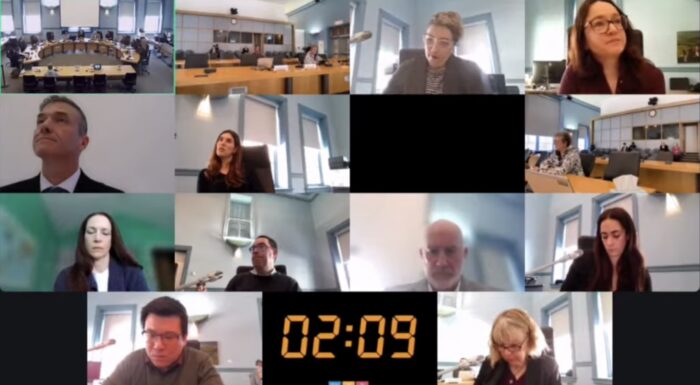
On February 26, 2026, Florence Lehmann delegated at the Public Works and Infrastructure Committee on the topic of right turns on red on behalf of Bike Ottawa. Below is the text as originally written. The delegation starts at 1:53:00.
Good morning,
Thank you for the opportunity to speak. I represent Bike Ottawa and I live in Vanier where many residents don’t have a car.
While I was getting ready to delegate, I was wondering why the banning of right turns on red (RTOR) even warrants a discussion. Why we have to defend the right to be safe outside of a car.
I read the staff report and I was struck by the picture it’s painting. It’s not about moving people safely. It’s about moving cars and getting drivers to their destination faster. And it doesn’t reflect the reality and complexity of getting around outside of a car. I’ll give you two examples of close calls I’ve had recently.
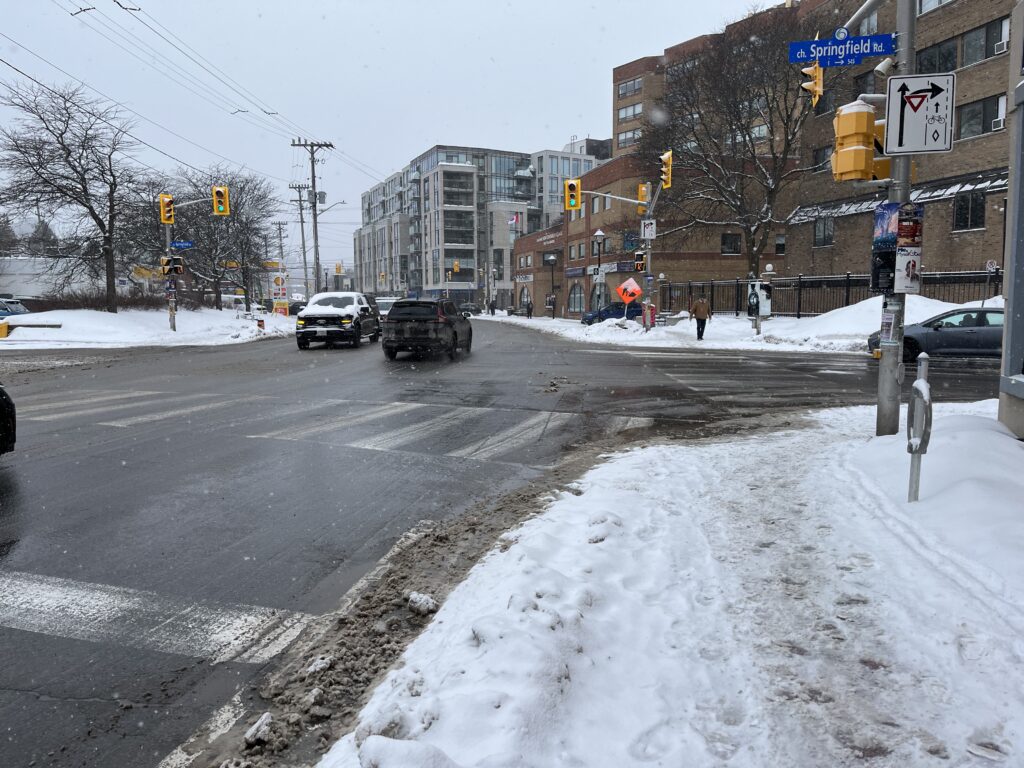
- Not long ago I was riding in a painted bike lane, then through an unprotected intersection, on a green light (no RTOR restriction). If I were to believe the report, I’d be more at risk with right-on-red restrictions as more drivers would turn right and into my space after the light turns green.
- Let me tell you the reality of things. If the light is green in the first place and I’m travelling with traffic towards the intersection, the danger is already there. In my case, the danger came from a driver turning right on red onto my street. Another part of the risk puzzle that’s not reflected in the report. The driver stopped at the last second, for the record.
- Another time, I was walking and had started crossing a street on a pedestrian green. A driver coming from my left was going to turn right on red and saw me at the last second. I jumped back. What would have happened if I assumed I could cross as I had the right of way? I wasn’t willing to find out.
- The report says RTOR restrictions can reduce risks at one crosswalk but then create more risks at the next crosswalk within the same intersection.
- There are solutions that can be used in conjunction with RTOR prohibition. It’s called dedicated signal phases. When I go back to my hometown of Besançon, in France, that’s how it works. No right on red and, whatever your mode of travel, either you have the green or you don’t. I must say it’s nice not to have to worry about being hit by a driver looking for an opening in traffic.
Now why should we cater to drivers based on possible non compliance of RTOR restrictions and possible aggressive behaviour? Why should we decide not to protect people walking, biking or rolling? This is backward thinking.
The data presented in the report is partial at best. It only includes collisions involving deaths or serious injuries. If you’re not seriously injured, you don’t count. What we need is a forward-looking, holistic approach to road safety that includes no RTOR, speed mitigation, better transportation options including better transit and a connected cycling network.
Now I’d like to leave you with a few figures:
- In 1981, a study by the US Department of Transportation showed that, after introducing RTOR, collisions involving people walking and biking had doubled.
- Fast forward to 2018, a study out of Washington DC showed that prohibiting RTOR resulted in a 97% reduction of conflicts between vehicles and a 92% reduction in failure to yield to pedestrians.
- A CAA study published in 2025 says near misses most often involved vehicles making a right turn. And 55% of pedestrians and 50% of cyclists had a close call with a vehicle.
In conclusion, is a right-on-red ban the way to go? Absolutely! It’s part of what the City should have in its toolbox. In the downtown core alone, over half of trips taken are done by other means than cars (Transportation Trends Report, May 30, 2024). That’s huge! A right-on-red ban would align with the City’s Official Plan that states that “the convenience and safety for pedestrians, cyclists and transit users shall take priority over private motor vehicle access in the Downtown Core” (Policy 5.1.2). I’d go even further. Eventually, we should ban RTOR across the City.
I ask you to ask yourself this question. Why is there such a disconnect between the staff report and users’ experiences? Why can Ottawa not be a city where there are ZERO deaths, when it is the case and stated goal in other cities, including Hoboken NJ where no one has been killed on their roads in 9 years; or Helsinki, a metropolis the size of Ottawa, that has just had no deaths on its roads in one year?
Thank you.